Vexora Pest DefenseVexora Pest Defense

Ant Control

Ant pressure in St. Mary's County is driven by moisture and construction style more than by housekeeping. Slab-on-grade homes around Patuxent Park and Carver Heights give pavement ants and odorous house ants a…
Call (240) 871-4139 →(240) 871-4139
Ant Control in Lexington Park, MD
Quick answer
  • What's included: an interior and exterior inspection to trace trails to the nest, species identification, gel or granular baiting where ants are feeding, a non-repellent exterior perimeter application, and a written list of the entry points and moisture sources feeding the colony.
  • How fast: most Lexington Park ant jobs are a single 60–90 minute visit; interior trails typically thin out within 3–10 days as bait moves back to the colony, since baiting kills the queen rather than the foragers.
  • What it costs: ant treatment in Lexington Park generally runs $250 to $450 for a standard single-family home, with carpenter ant work higher because it involves drilling and void treatment. $250 is our minimum charge.
  • What we take: cash, check, and major credit and debit cards, paid after the work is done.
  • How to book: call or text (240) 871-4139 for an on-site inspection — the price is quoted from what we find at the house, not guessed over the phone.

Ant pressure in St. Mary's County is driven by moisture and construction style more than by housekeeping. Slab-on-grade homes around Patuxent Park and Carver Heights give pavement ants and odorous house ants a ready-made highway: they nest under the slab or along expansion joints in the driveway and walk in through the smallest gap at the sill plate or around a plumbing penetration. In the newer sections of Wildewood and Chancellors Run Estates, irrigated mulch beds pushed tight against the foundation hold exactly the damp, protected space odorous house ants prefer, and every bed edge sitting above the brick line is a bridge over whatever was sprayed on the wall. On wooded lot lines in Bay Forest, Hickory Hills and Town Creek, the calls are more often carpenter ants working out of a dead limb, a rotted deck post, or wet trim under a gutter seam — bigger ants, sawdust-like frass, and a nest that has to be found rather than fogged.

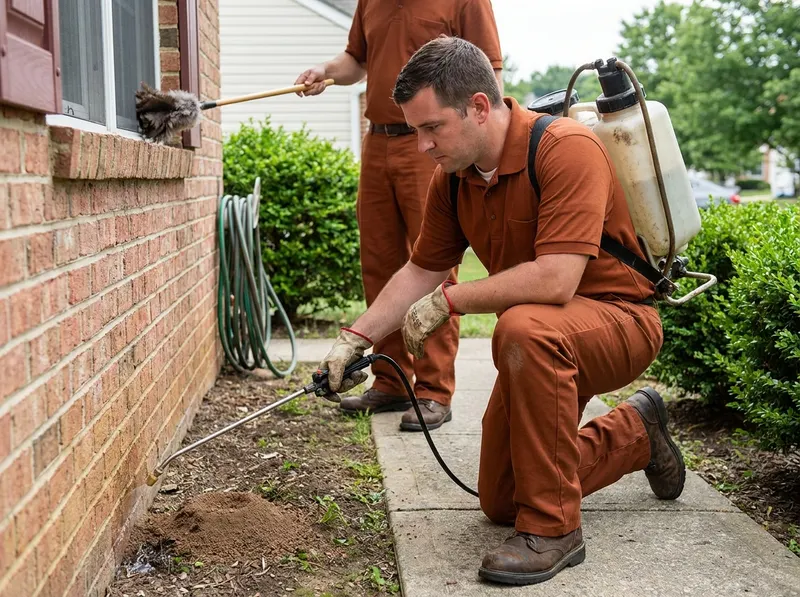
Here is the trade-off that decides the treatment plan. A contact spray on a visible trail kills what you can see and looks like a win for two days. With odorous house ants it often does the opposite of what you want: repellent product applied to an active trail can push a colony to split into satellite nests, so one line on the counter becomes three lines in two rooms. We use non-repellent materials on the exterior perimeter and place bait where the ants are already feeding, so foragers carry the active ingredient back and feed it to the brood and queen. It is slower to look impressive and far more likely to actually end the colony. That is the whole idea behind a perimeter held, not a spray.

One visit is the right call when the trail is fresh, the species is a household nuisance ant, and we can identify a specific outside source — a mulch bed, a downspout dumping at the corner, a woodpile against the garage. A recurring quarterly program is the honest recommendation when the property itself keeps re-seeding: heavy tree canopy, a lot line against woods off Three Notch Trail, a crawlspace holding humidity through a Southern Maryland August, or a rental turnover schedule near Naval Air Station Patuxent River where nobody is home to catch the first trail. Programs are cancelable — no locked multi-year agreement, and no auto-billing you can't stop with a phone call.

Carpenter ants are treated as their own job, not an upsell. They excavate galleries in damp wood rather than eat it, so the fix is finding the moisture that softened the wood in the first place — a leaking hose bib, a failed flashing, a deck ledger — and treating the void directly, then telling you what carpentry or gutter work will keep them from coming back. We will say plainly if the real problem is a repair rather than a product. We also do not blanket-fog interiors of occupied homes; there is no reason to put material where your kids and pets are when the nest is in the landscaping.

What it costs

Single-family ant treatment (odorous house, pavement, little black ants)$250 – $450
Ant treatment, larger home or heavy multi-room activity$375 – $550
Carpenter ant treatment with void drilling and moisture assessment$350 – $700
Quarterly perimeter program covering ants (per visit, cancelable)$250 – $325
Rental turnover / pre-move-in ant service, Lexington Park areafrom $250

Every job gets a firm, written price after a free on-site visit.

Common questions

Why do ants keep coming back to my Lexington Park kitchen after I spray them?
Because store spray kills foragers, not the colony. The 5% of ants you see on the counter are scouts; the queen and brood stay in a nest that is usually outside the wall in mulch, under a slab edge, or in damp wood. Killing the trail removes the evidence and leaves the source, so a new trail appears within days. Bait that gets carried back to the nest is what ends the cycle.
What kind of ants are most common in Lexington Park homes?
Odorous house ants and pavement ants account for most Lexington Park indoor ant calls — small dark ants trailing along countertops, baseboards, and sidewalk joints. Carpenter ants show up more on wooded lots in Bay Forest, Hickory Hills and Town Creek, where damp wood and overhanging limbs give them a place to nest. Identification changes the treatment, which is why we look at the ant before quoting the job.
How much does ant control cost in Lexington Park, MD?
Most Lexington Park ant treatments fall in the $250 to $450 range, with carpenter ant work running higher because it requires locating and treating nest voids. $250 is our minimum charge. These are ballparks — the exact number comes from the on-site inspection, based on the size of the home, how many rooms are active, and what is happening on the exterior.
Do I need a quarterly plan, or can you treat ants in Lexington Park one time?
A single treatment is often enough for a Lexington Park home with one clear trail and an identifiable outside nest. A recurring perimeter program makes more sense for houses backing woods, homes with crawlspace humidity, and rentals near Pax River that turn over between tenants. We tell you which one fits after the inspection, and any program can be canceled.
Will you have to spray inside my Lexington Park house?
Usually very little. Most of the work happens on the exterior perimeter, in mulch beds, and at entry points, with small, targeted bait placements indoors where ants are actively feeding — under sinks, behind appliances, along trailing edges. We do not blanket-fog occupied interiors. Call (240) 871-4139 and we will walk you through exactly where product goes before anything is applied.

Ready to get started?

Tell us about your ant control job in Lexington Park and we'll send a clear, written quote — usually the same day.