Vexora Pest DefenseVexora Pest Defense

Rodent Control

Two rodents drive nearly every call in this part of St. Mary's County. The house mouse is the one found under kitchen sinks and behind dishwashers in Patuxent Park, Carver Heights and the older rental stock near Great…
Call (240) 871-4139 →(240) 871-4139
Rodent Control in Lexington Park, MD
Quick answer
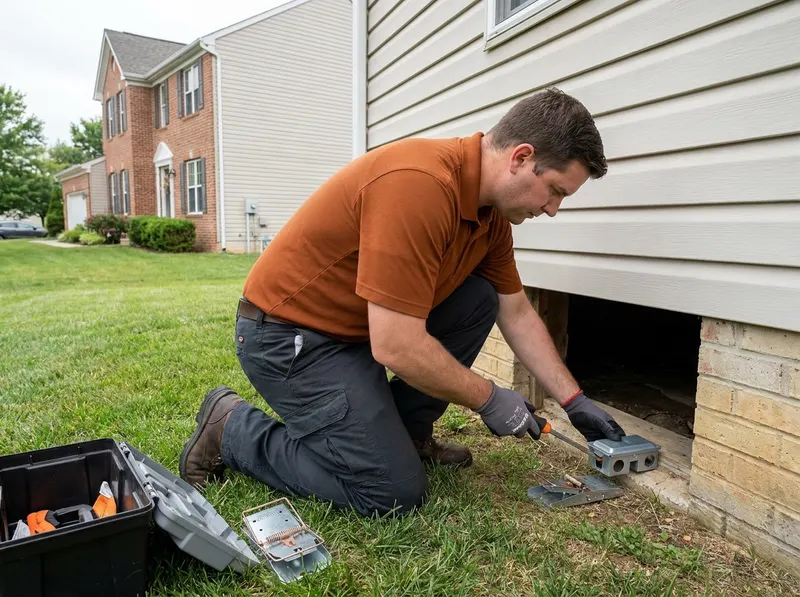
  • Included: a full interior and exterior inspection, written entry-point findings, trap and tamper-resistant bait placements where appropriate, sealing of accessible gaps, and a follow-up visit to remove catches and verify activity has stopped.
  • Speed: inspections are typically scheduled within a few business days; trapping usually reduces visible activity in the first one to two weeks, and heavy infestations in older crawlspace homes can run four to six weeks.
  • Cost: most Lexington Park rodent jobs land between $250 and $650 for inspection, trapping and basic sealing, with larger exclusion work quoted separately. $250 is the minimum charge.
  • What we take: cash, check, and major credit and debit cards. Landlords and property managers can be invoiced per address.
  • Booking: call or text (240) 871-4139 with your neighborhood and what you're seeing — droppings, gnawing at night, a scratching sound in the ceiling — and we set an on-site inspection. The exact price is confirmed at that visit, not guessed over the phone.

Two rodents drive nearly every call in this part of St. Mary's County. The house mouse is the one found under kitchen sinks and behind dishwashers in Patuxent Park, Carver Heights and the older rental stock near Great Mills Road — droppings the size and shape of a rice grain, dark and scattered along baseboards. Norway rats show up around Town Creek, along storm drains, and near commercial dumpster corridors like San Souci Plaza and St. Mary's Square, where a burrow at the foundation line and a greasy rub mark on a downspout tell the story. Wooded lot lines in Bay Forest, Hickory Hills and along the Three Notch Trail edge add white-footed mice, which move indoors as soon as October nights cool off. Field-mouse pressure spikes again after the surrounding corn and soybean ground is harvested near Chancellors Run Estates and Greenview Knolls.

Here is the decision that matters. If you have seen droppings for less than a couple of weeks in one room, trapping plus targeted sealing usually finishes it, and that is the least expensive path. If you are hearing movement overhead, finding droppings in more than one room, or the home has an open crawlspace, a slab penetration at the plumbing, or a soffit and gable vent that daylight shows through, then exclusion is the job and trapping is only the cleanup. Bait-only programs are the alternative some companies sell because it is fast and cheap to install. The trade-off is real: bait can reduce a population without ever closing the hole, so next fall the same route reopens, and a rodent that dies inside a wall cavity becomes an odor and fly problem. We do not blanket-fog interiors, and we do not place bait indoors where children or pets can reach it.

Lexington Park construction shapes the work. Slab-on-grade homes hide entries where the water line and sewer stack pass through the slab, plus dryer vents and utility chases that were never properly collared. Crawlspace homes in Esperanza and Cedar Cove combine Chesapeake humidity with insulation that mice shred for nesting, so we look for moisture and grade issues at the same visit — a wet crawlspace re-seeds pests no matter how much is sprayed above it. Townhome and duplex layouts around Wildewood share wall cavities, which means a neighbor's problem can arrive through a common wall; we note that plainly rather than pretend a one-unit seal solves a building-wide route.

Pax River turnover creates its own pattern. Homes that sit empty between PCS moves lose the daily disturbance that keeps rodents cautious, and a stored bag of birdseed or dog food in a garage will hold a colony through winter. If you are handing over keys or taking possession, an inspection before the furniture arrives is far cheaper than one after.

Every visit ends with what we found and where — gaps measured, entry points photographed, conducive conditions listed — so you own the findings whether or not you hire us for the sealing work. Ongoing rodent monitoring is available, and any program we set up can be cancelled; there is no auto-renewing contract you cannot get out of.

What it costs

Rodent inspection with written entry-point findings$250 (minimum charge, credited toward treatment)
Mouse job — trapping plus basic gap sealing, single-story home$275 – $450
Multi-room or multi-level mouse infestation with follow-up visits$450 – $750
Norway rat control — burrow work, exterior stations, exclusion at foundation$400 – $900
Crawlspace or attic exclusion — vents, soffits, slab and pipe penetrations$600 – $2,000+ depending on linear footage and access
Ongoing rodent monitoring after cleanout (per visit)From $250
Rental turnover / pre-move-in rodent inspection$250 – $350

Every job gets a firm, written price after a free on-site visit.

Common questions

How much does rodent control cost in Lexington Park?
Most Lexington Park rodent jobs run $250 to $650 for inspection, trapping and basic sealing; $250 is our minimum charge. Larger exclusion work — an open crawlspace, damaged soffits, multiple slab penetrations — is quoted separately after we measure the openings. Every figure here is a ballpark; the exact price is confirmed on-site.
How long does it take to get mice out of a Lexington Park home?
A typical Lexington Park mouse cleanout shows a clear drop in activity within one to two weeks of the first trapping visit. Older crawlspace and slab homes in areas like Patuxent Park or Esperanza with an established population can take four to six weeks, because trapping continues until the catch count reaches zero and the sealing holds.
Do you use poison bait inside Lexington Park houses?
No. Inside Lexington Park homes we trap rather than bait, so the rodent is removed instead of dying in a wall cavity. Tamper-resistant bait stations are used outdoors only, along foundations and near burrows, and never within reach of children or pets.
Why do mice keep coming back to my Lexington Park townhome every fall?
Fall returns in Lexington Park townhomes almost always mean an unsealed route, not a failed treatment. Cooling October nights push house mice and white-footed mice indoors, and shared wall cavities in Wildewood-area townhomes and duplexes let them travel between units. Sealing the exterior gaps — dryer vents, utility chases, garage door corners — is what breaks the annual cycle.
Can you handle rodent control for a Lexington Park rental between tenants?
Yes. Vacant rentals around Lexington Park and Great Mills are our easiest and cheapest rodent jobs, because traps and sealing can be installed with no furniture in the way and no occupants to work around. Landlords and property managers receive a per-address invoice and a written record of entry points and conducive conditions for the file.

Ready to get started?

Tell us about your rodent control job in Lexington Park and we'll send a clear, written quote — usually the same day.