Termite pressure in Lexington Park is a spring story. Eastern subterranean termites swarm here on warm, damp afternoons roughly from late March through May, and the first thing most homeowners notice is not an insect…
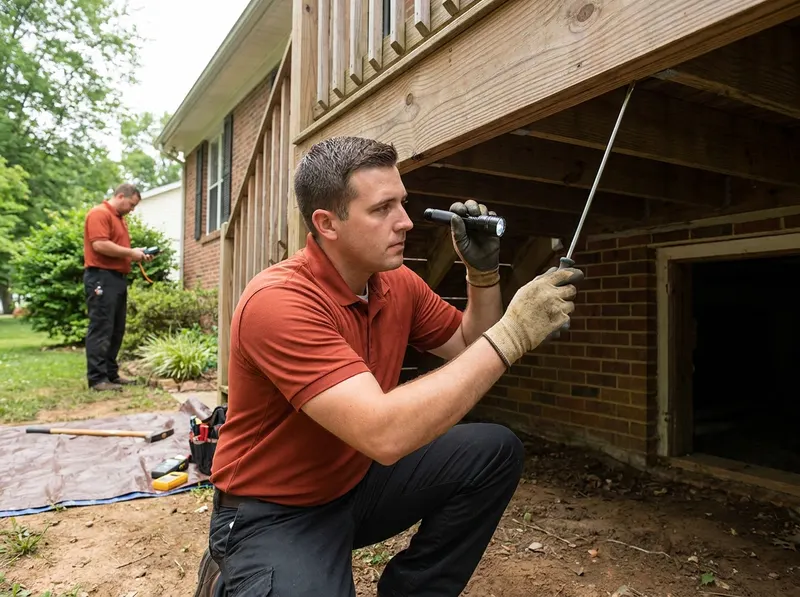
Termite pressure in Lexington Park is a spring story. Eastern subterranean termites swarm here on warm, damp afternoons roughly from late March through May, and the first thing most homeowners notice is not an insect but a scatter of translucent wings on a sill or in a window track near a slider. If you are seeing that in Wildewood or Chancellors Run Estates, an inspection now settles the question, because swarmers indicate a colony that has been established for years, not one that arrived last week. Mud tubes are the other tell — pencil-width soil tunnels running up a block foundation or a pier in a crawlspace, most often on the shaded north or east side of the house where the ground stays wet.
Housing stock here changes what we look at. Slab-on-grade homes in Patuxent Park and Carver Heights hide activity at the slab edge, behind baseboard, and around bathroom plumbing penetrations, so inspection means probing trim and checking expansion joints rather than crawling. Older homes toward Town Creek and Hickory Hills tend to have crawlspaces where the sill plate, band joist, and pier bases carry the evidence, and where Chesapeake humidity keeps wood moisture high enough to invite the colony back. Newer construction in Bay Forest, Cedar Cove, Esperanza and Greenview Knolls usually has a pre-construction treatment history worth asking about, plus the two conducive conditions we flag most often in this county: mulch mounded above the foundation weep line and downspouts discharging within a foot of the wall. Wooded rear lot lines — the sort backing to the Three Notch Trail corridor or the treeline near Great Mills — put more cellulose debris and stumps within foraging distance.
Decide between an inspection and a treatment quote this way. If you have no visible evidence and simply want to know where you stand before a Pax River PCS move, a refinance, or a resale, the inspection alone is the right purchase — it may end with a clean report and a short punch list of grading and moisture fixes that cost you nothing but a Saturday. If you already have mud tubes on the wall or damaged wood, the inspection still comes first, because linear footage of foundation, slab versus crawlspace, and bath trap locations determine which treatment is appropriate and what it will cost. The trade-off is honest: an inspection is money spent on information, and some homeowners want to skip straight to a price. A phone-guess price on a house nobody has walked is a number, not a plan.
If the inspection is tied to a closing, tell us when you call. Settlement and title companies handling St. Mary's County transactions generally want a written wood-destroying insect report on the standard industry form, and the paperwork needs to match what your lender asked for. We document what we found, note any areas that were inaccessible, and stay explicit about the limits of a visual inspection — no blanket indoor fogging is ever part of this visit, and nothing is treated without your written go-ahead.
Every job gets a firm, written price after a free on-site visit.
Tell us about your termite inspection job in Lexington Park and we'll send a clear, written quote — usually the same day.
 Vexora Pest Defense