Camel crickets in St. Mary's County are usually one of two things: the native brown Ceuthophilus, or the invasive greenhouse camel cricket (Diestrammena) that has taken over mid-Atlantic basements over the past two…
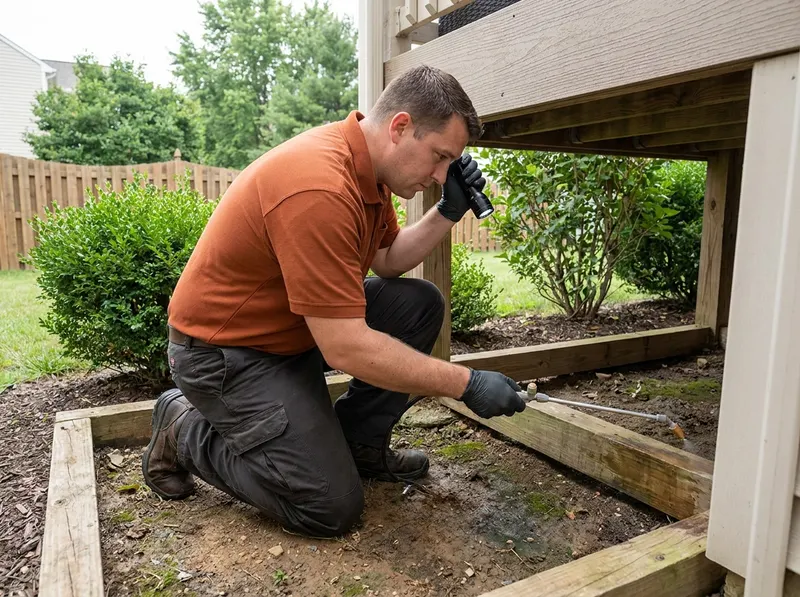
Camel crickets in St. Mary's County are usually one of two things: the native brown Ceuthophilus, or the invasive greenhouse camel cricket (Diestrammena) that has taken over mid-Atlantic basements over the past two decades. Neither bites, neither chirps, and neither breeds in your ductwork. Both lay eggs in damp soil, which is why the population lives under the house and only the strays end up in the hallway at 11pm. That's the part homeowners find out too late after a hardware-store spray: you can kill the twenty you see and still have several hundred under the vapor barrier. Treating the room is cosmetic. Treating the soil-level harborage, the foundation vents, the crawl door and the mulch line is what actually drops the count.
Lexington Park geography makes this a recurring call. Older block-foundation rentals in Patuxent Park and Carver Heights sit close to grade with vented crawlspaces that stay humid all summer. Homes backing wooded lot lines in Bay Forest, Town Creek, Hickory Hills and Cedar Cove have leaf litter and shade holding moisture right where the crickets want it. Newer construction in Wildewood, Esperanza and Chancellors Run Estates isn't exempt — an unconditioned crawlspace with a torn vapor barrier and a gap under the crawl access door is a perfect nursery, and Chesapeake humidity does the rest. In Greenview Knolls we see the same pattern through garage door sweeps and sump pits. The crickets move indoors in two waves: late spring as they mature, and again in fall when outdoor conditions dry or cool.
One-time service versus a quarterly program is a real decision, and the honest split is this. A single targeted service fits when the inspection finds a contained source — one crawlspace, one window well, a garage side door with no sweep — and you're willing to fix the moisture or gap we write up. A quarterly perimeter program fits wooded lots, homes with chronic crawlspace humidity, and landlords managing Pax River rental turnover, because the outdoor population re-pressures the foundation every season no matter how clean the interior is. The trade-off is money against re-entry: one visit costs less and can hold for a season, ongoing service costs more over a year and keeps the perimeter defended through both migrations. Our programs are billed per visit and you can cancel — no locked term.
What we will not do is fog the inside of your house. Blanket indoor fogging puts product where camel crickets don't live and does nothing to the egg-laying soil under the floor. We also won't quote a firm price from a phone description — access, crawlspace size, foundation type and lot conditions change the number too much. You get the inspection findings first: where they're getting in, what's holding the moisture, how many are hitting the glue boards. Then a price. If the fix is a dehumidifier, a graded downspout or a crawl door that closes, we'll tell you that even though it isn't a treatment we're selling.
Every job gets a firm, written price after a free on-site visit.
Tell us about your camel cricket control job in Lexington Park and we'll send a clear, written quote — usually the same day.
 Vexora Pest Defense